Table of Contents
- Why Charter Bus Safety Standards for Schools Matter for School Trips
- Charter Bus vs. School Bus: What Standards Actually Apply
- Charter Bus Driver Background Check Requirements
- Charter Bus Pre-Trip Inspection Checklist
- How to Verify a Charter Bus Company Safety Record
- Building a School Trip Transportation Safety Plan
- Conclusion
- Frequently Asked Questions
Last Updated: October 5, 2026
Why Charter Bus Safety Standards for Schools Matter for School Trips
Charter bus safety standards for schools are the rules, inspections, and driver requirements that govern group travel on motorcoaches carrying students. At Holiday Coach Lines, we specialize in safe, reliable group transportation for events, weddings, sports teams, and corporate travel, and the questions we hear most often are about exactly this: who checks the bus, who checks the driver, and who is accountable when something goes wrong.
The answer is layered. Federal rules set the floor, state regulations add requirements, and the school or district adds its own policy on top. Understanding where each layer applies is the difference between a compliant trip and a liability exposure.
The core distinction: school buses and charter buses are regulated differently. A district-owned yellow bus follows one set of federal construction and operating rules; a commercial motorcoach follows another. Knowing which applies to your trip prevents false assumptions about seat belts, inspections, and driver vetting.
Charter Bus vs. School Bus: What Standards Actually Apply
A school bus and a charter bus are not the same vehicle, and they do not follow the same rulebook.
That difference matters when a district hires an outside company for a field trip or an athletic road trip.
For a deeper look at how federal motor carrier rules apply, see the Federal Motor Carrier Safety Administration, which sets the baseline for commercial bus operations.
| Question | School Bus | Charter Bus |
|---|---|---|
| Who owns it | Usually the district | A commercial carrier |
| Governing rules | Federal school bus construction standards | Federal motor carrier safety rules |
| Typical use | Daily routes | Field trips, athletics, events |
| Driver vetting | District hiring process | Carrier screening plus federal requirements |
Charter Bus Driver Background Check Requirements
Charter bus driver background check requirements are among the most important things a school should verify before booking.
A school or district should ask the carrier for documentation, not just a verbal assurance. The most useful items are the driver’s commercial license status, the carrier’s drug and alcohol testing program, and confirmation that the driver has passed a background check.
A common mistake is accepting a carrier’s word that “all our drivers are vetted” without seeing documentation. If a driver’s record or testing status is not verifiable, the school absorbs part of the liability. Ask for the paperwork before the contract is signed, not the morning of the trip.
Charter Bus Pre-Trip Inspection Checklist
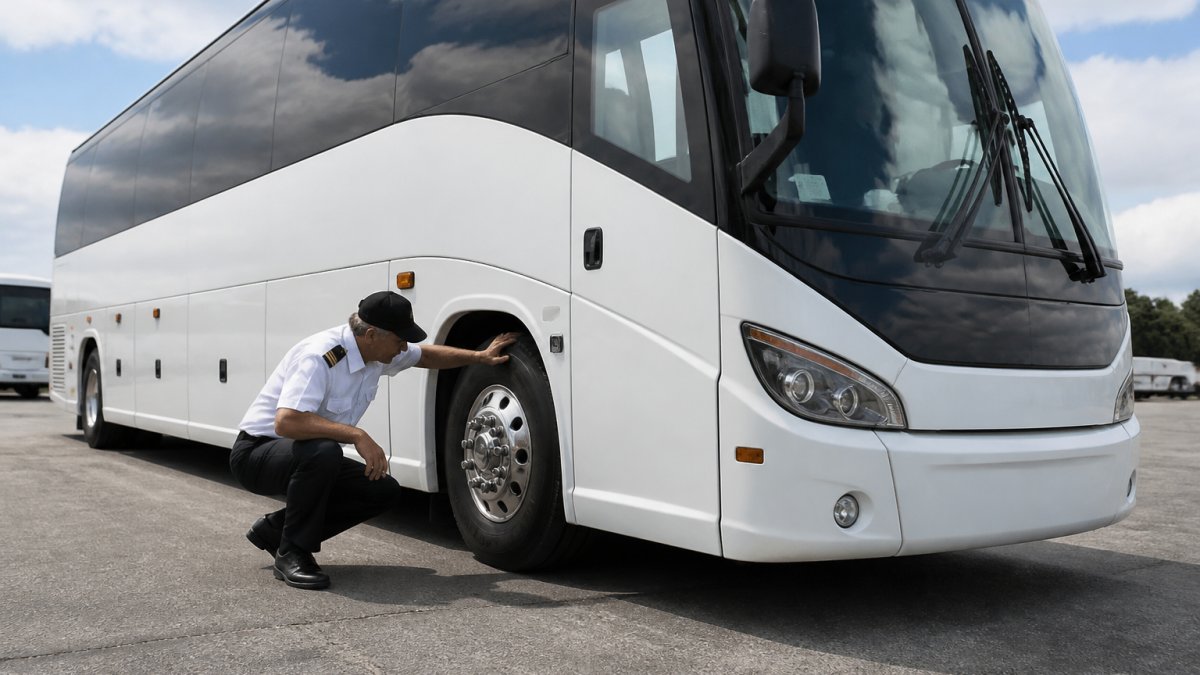
A charter bus pre-trip inspection checklist is a documented walk-around and systems check a driver completes before every departure. It covers tires, brakes, lights, mirrors, emergency exits, and fluid levels, and the driver signs off on the results.
What the Driver Is Actually Checking
The federal standard requires a commercial driver to be satisfied the vehicle is in safe operating condition before driving. In practice, a thorough pre-trip walk-around covers six zones:
- Tires and wheels, pressure, tread depth, sidewall damage, lug nuts, and signs of uneven wear that suggest alignment or brake problems
- Brakes and air system, air pressure build-up and loss rates, brake adjustment, and the low-pressure warning system
- Lighting and signals, headlights, brake lights, turn signals, hazard flashers, clearance lights, and reflectors
How a School Verifies the Inspection Happened
This is where most guides stop, and where a school can separate a serious carrier from a casual one. The inspection is only meaningful if it is documented and retained. Ask the carrier three specific questions before booking:
- Is the pre-trip inspection recorded on a driver vehicle inspection report (DVIR)? Federal rules require a DVIR when a driver finds a defect, and carriers must retain those reports. A carrier that keeps DVIRs for every trip, not just defect trips, has a stronger maintenance culture.
- How long are inspection records retained? Most carriers keep them for at least the federal minimum, and many keep them longer for insurance and audit purposes. Ask for the retention period in writing.
- Can you provide a sample completed inspection report? A redacted sample shows you the actual form, the sign-off, and the defect-tracking process, not a marketing description of it.
A common mistake is accepting a carrier’s word that “all our buses are inspected” without seeing the documentation trail. A pre-trip inspection that is not recorded is difficult to prove after an incident. Ask for the retention policy and a sample report before the contract is signed, not the morning of the trip.
Post-Trip and Periodic Inspections
The pre-trip check is the driver’s daily responsibility, but it is not the only layer. Federal rules also require periodic inspection, repair, and maintenance, and carriers must maintain records of those activities. For a school, the practical question is whether the carrier can show a maintenance schedule and records that match the vehicles assigned to the trip. A carrier that tracks pre-trip, post-trip, and periodic maintenance consistently is a carrier that takes vehicle safety seriously, and that is the standard a school should hold every vendor to.
How to Verify a Charter Bus Company Safety Record
Verifying a charter bus company safety record starts with the carrier’s federal operating authority and safety rating. The federal government maintains a public database where you can look up a carrier’s authority status, insurance, and crash history. This is the single most useful step a school can take before signing a contract.
Beyond the federal database, ask the carrier for:
- Proof of current insurance and operating authority
- Its most recent vehicle inspection results
- Driver qualification files, summarized
A carrier with a clean record will answer these questions without hesitation. A carrier that deflects is telling you something.
What most guides miss: the federal safety database is public and free. Spend ten minutes there before you book. You can confirm operating authority and see crash and inspection history in one place, which is far more reliable than a reference call the carrier selected for you.
Building a School Trip Transportation Safety Plan
A school trip transportation safety plan is a written document that assigns responsibility for every stage of the trip, from booking to return. It should name who approves the carrier, who verifies documents, who supervises students on board, and who is contacted in an emergency.
Most guides stop there. The gap in nearly every ranking result is a practical framework that separates federal baseline requirements from state and district variations, and that gives a school a real vendor-vetting checklist instead of a vague instruction to “choose a reputable company.” The framework below fills that gap.
Federal Baseline vs. State and District Rules
Federal rules set the floor for commercial motorcoach operations. The Federal Motor Carrier Safety Administration (FMCSA) establishes driver qualification, hours-of-service, drug and alcohol testing, vehicle inspection, and insurance requirements that apply regardless of which state the trip originates in.
State and district rules add requirements on top. A state education agency may impose additional driver background check requirements, vehicle age limits, or inspection intervals for any bus carrying students.
Before booking, ask the district transportation office two questions: (1) Does the district maintain a list of approved charter carriers, and (2) What documentation does the district require before a vendor can be approved? The answers define the actual standard your trip must meet, which may be stricter than federal law.
Vendor-Vetting Checklist
Use this checklist to evaluate a charter operator before signing a contract. Each item should be verifiable with a document, not a verbal assurance.
Operating authority and insurance
- Active operating authority confirmed through the FMCSA’s public database
- Certificate of insurance showing current commercial auto liability coverage at or above the district’s required limits
- Additional insured endorsement naming the school or district, if required by policy
Driver records
- Commercial driver’s license (CDL) with the correct class and passenger endorsement
- Pre-employment screening and ongoing drug and alcohol testing program
- Query of the FMCSA Drug and Alcohol Clearinghouse
Vehicle condition and maintenance
- Most recent inspection results for the vehicles assigned to the trip
- Maintenance schedule and records retention policy
- Pre-trip inspection documentation process (see the inspection section above)
Compliance documentation
- Signed transportation agreement with clear liability and indemnification terms
- Emergency contact and incident response procedures
- Accessibility accommodations confirmed for any student with mobility or medical needs
Trip-Specific Planning for Field Trips, Athletics, and Non-Routine Travel
Regular route transportation and non-routine trips are not the same problem. A field trip, an athletic road trip, or an out-of-town competition adds variables that a daily route does not: unfamiliar loading zones, longer distances, overnight stays, and a different supervision ratio.
A trip-specific plan should address:
- Passenger manifest, a list of every student, chaperone, and staff member on board, with emergency contacts, kept by the lead chaperone and a copy with the school office
- Loading and unloading zones, a designated meeting point at the destination, with supervision at the curb and a headcount before and after every boarding
- Supervision ratio, a chaperone-to-student ratio appropriate to the age group and trip type, confirmed in advance with the carrier
- Emergency contacts, a single point of contact at the school and at the carrier, with a backup for each
- Accessibility and medical needs, confirmed accessible vehicle, securement equipment, and any medication or accommodation plan coordinated with the carrier before departure
Incident Reporting and Continuous Improvement
A safety plan is only as good as its feedback loop. After every trip, the school should capture what happened and feed it back into the next booking decision.
- Incident log, record any crash, near miss, breakdown, or behavioral issue, with date, carrier, vehicle, and a short description
- Inspection and training tracking, note whether the carrier provided current inspection records and driver qualification documentation on request
- Complaint and corrective action record, track any issue raised by chaperones or students and whether the carrier responded
Documenting this consistently does two things: it protects the school if an incident occurs, and it gives the district a factual basis for deciding which carriers to keep on its approved list.
For guidance on emergency preparedness in school settings, the Readiness and Emergency Management for Schools Technical Assistance Center offers resources that districts can adapt.
Conclusion
The hardest part of school trip transportation is not booking the bus; it is proving, on paper, that every safety box was checked before the wheels turned. Department of Transportation and the Interstate Commerce Commission, and staffed by hand-picked professional drivers chosen for their safety records and customer service. Our motorcoaches are maintained to high standards and equipped with 57 reclining seats, air conditioning, free Wi-Fi, and USB chargers.
Request a quote today and let us handle the safety documentation so your team can focus on the trip.
Frequently Asked Questions
What safety standards should schools require for charter buses?
Schools should require that any charter bus company meets Federal Motor Vehicle Safety Standards, carries at least $5 million in liability insurance, and holds active operating authority from the Federal Motor Carrier Safety Administration. Drivers must have a valid commercial driver’s license with passenger endorsement, pass pre-employment and random drug testing, and complete emergency response training. Vehicles should pass regular preventive maintenance inspections. Ask for documentation of all these items before signing a contract.
How can a school verify a charter bus company’s safety record?
Check the company’s safety record through the FMCSA’s Safety Measurement System database, which tracks crashes, inspections, and out-of-service violations. Request the company’s USDOT number and motor carrier authority, then look up their records directly. Ask for proof of insurance and confirm the policy is current. A company with a clean record will provide this information without hesitation. Also check whether the company has any unresolved complaints with the Better Business Bureau.
What qualifications should a charter bus driver have for a school trip?
Drivers transporting students should hold a valid commercial driver’s license with a passenger endorsement and no disqualifying traffic violations. They need a current Department of Transportation medical examiner’s certificate, a clean background check including fingerprinting, and completion of pre-employment and random drug and alcohol testing. Many districts also require defensive driving certification and annual emergency training. Ask the charter company for written confirmation of each driver’s credentials before the trip.
What should schools check during a charter bus inspection?
Before boarding, check that the bus displays a current inspection sticker and valid registration. Look at tire tread depth and pressure, ensure all lights and turn signals work, and confirm emergency exits open properly. Inside, verify seat belts are functional, the fire extinguisher is charged, and the first aid kit is stocked. Ask the driver to show you the pre-trip inspection report. If anything fails, do not board the bus and contact the charter company immediately.
Are charter buses required to meet the same standards as school buses?
No. School buses must meet federal standards specifically designed for student transport, including compartmentalization, stop arms, and yellow color requirements. Charter buses follow different Federal Motor Vehicle Safety Standards for commercial motorcoaches. Charter buses are not required to have stop arms or the same crash protection features as school buses. Schools should understand this difference and verify that the charter company exceeds minimum federal requirements for passenger safety.
What documents should a school request from a charter bus company?
Request a copy of the company’s operating authority, certificate of insurance with at least $5 million in liability coverage, USDOT and motor carrier numbers, driver qualification files for assigned drivers, and the most recent vehicle inspection reports. Also ask for the company’s safety rating from the FMCSA, a written emergency response plan, and proof of ongoing driver training. Keep copies on file for your records and review them annually.