Table of Contents
- Transportation Options for Group Transportation for Cruise Ports
- Charter Bus to Cruise Port: Capacity, Luggage, and Comfort
- Cruise Port Shuttle for Groups: When Shared Rides Make Sense
- Airport Transfer for Cruise Groups: Timing Your Arrival and Departure
- Transportation for Large Groups to Cruise Port: Vehicle Sizing and Logistics
- Cost Factors and Per-Person Comparisons for Group Cruise Port Transportation
- Booking Checklist and Questions to Ask Your Transportation Provider
- Frequently Asked Questions
Last Updated: October 4, 2026
Transportation Options for Group Transportation for Cruise Ports
Group transportation for cruise ports is the coordinated movement of multiple travelers and their luggage between airports, hotels, and a cruise terminal using a single booked vehicle or a managed fleet. It solves the hardest part of any cruise: getting everyone to the ship on time, together, without a scramble for rides at the curb.
This guide from Holiday Coach Lines draws on our experience moving groups across Florida. We run motorcoaches for wedding parties, sports teams, church groups, and tour operators, so we know exactly where group logistics fall apart.
Below, we break down the three main options, then show you how to size a vehicle, plan around cruise-day timing, and ask the right questions before you book.
Most groups choose between three formats. Each one fits a different size, budget, and tolerance for shared space.
| Option | Typical Group Size | Luggage Handling | Best For |
|---|---|---|---|
| Charter bus | 30-57 passengers | Underfloor compartments | Large groups, one pickup |
| Shared shuttle | 10-24 passengers | Limited per person | Smaller parties, flexible timing |
| Private transfer | 1-14 passengers | Trunk space only | VIPs, tight schedules |
Charter Bus
A charter bus is a single vehicle booked for your group alone, with no other passengers and no intermediate stops. For cruise travel, that means one pickup, one drop-off at the terminal, and a driver who waits for your schedule rather than the other way around.
The math favors charters fast. You also get one point of contact and one vehicle to track instead of a convoy.
The trade-off is commitment. A charter runs on your timetable, so if your flight lands late, you absorb that cost in driver wait time. It also needs a staging area at both ends, which matters at crowded terminals.
Shared Shuttle
A shared shuttle is a fixed-route or semi-fixed service that carries multiple unrelated parties, often on a set schedule. It is the middle ground: cheaper than private, more structured than a rideshare.
Shared shuttles work well when your group is small and your timing is flexible. If your flight lands at midday and your ship boards in the evening, a shared ride absorbs the slack without costing you a dedicated vehicle.
The catch is luggage. Shared shuttles often cap bags per person, and a group with heavy cruise luggage can hit those limits quickly. Confirm the allowance before you book.
Private Transfer
A private transfer is a dedicated vehicle, usually a sedan, SUV, or van, booked for your party only. It is the fastest option for small groups and the easiest to schedule around a tight window.
For a group of four to eight with standard bags, a private van is often the simplest choice. You get door-to-door service and a driver focused on your arrival time.
Private transfers stop making sense as group size climbs. Above about 14 passengers, you are booking multiple vehicles and losing the coordination benefit that made the option attractive.
Charter Bus to Cruise Port: Capacity, Luggage, and Comfort
A charter bus to a cruise port carries 30 to 57 passengers in a single vehicle, with underfloor luggage compartments that hold far more than any van or SUV.
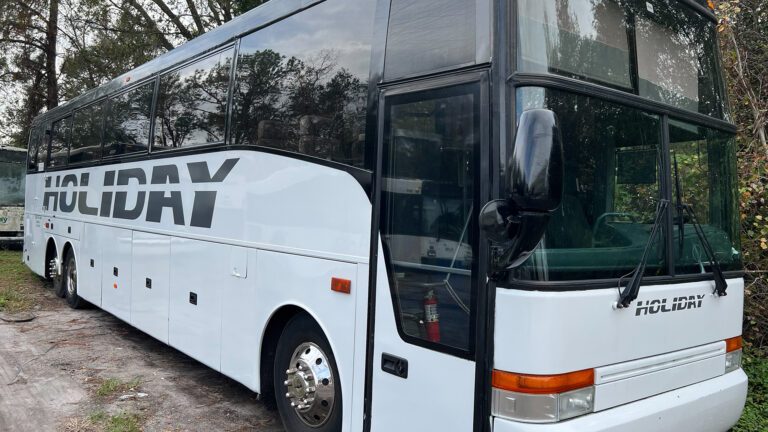
Our motorcoaches seat up to 57 passengers on reclining seats, with air conditioning, free Wi-Fi, and USB chargers at every row. For a group arriving from a hotel or airport, that means everyone travels together and nobody fights over outlet space.

Luggage capacity is the quiet advantage. A full motorcoach swallows hundreds of bags in the belly compartments, which keeps the cabin clear and speeds up unloading at the terminal.
Comfort matters on longer runs. If your group is coming from a hotel two hours from the port, reclining seats and a restroom-equipped coach change the experience.
Ask your provider to confirm the undercarriage capacity in bags, not just passenger seats. A 57-seat coach and a 30-seat minibus differ enormously in luggage room, and cruise groups always carry more than they estimate.
Cruise Port Shuttle for Groups: When Shared Rides Make Sense
A cruise port shuttle for groups makes sense when your party is small, your schedule has slack, and your budget is tight. Shared shuttles trade a little convenience for a lower fare, and that trade works best when nobody is racing a boarding deadline.
There are real limits to watch. Shared shuttles may stop at multiple terminals or hotels, which adds time. They may also cap luggage, so a group with oversized bags can get turned away or charged extra.
For groups that need flexibility without a full charter, a hybrid approach works: book a shared shuttle for the airport-to-hotel leg, then a dedicated vehicle for the hotel-to-port run on cruise morning. That splits the cost where it hurts least and protects the one leg that cannot go wrong.
Airport Transfer for Cruise Groups: Timing Your Arrival and Departure
An airport transfer for cruise groups should be booked with a buffer that accounts for flight delays, baggage claim, and terminal traffic. The standard advice is to land at least one full day before your cruise departs, and to book your transfer for a window, not a fixed minute.
Cruise lines typically require passengers to be on board well before the ship sails, and the exact cutoff varies by line and itinerary. Check your cruise documents for the specific all-aboard time rather than assuming, and treat that deadline as immovable.
For departure day, the reverse applies. Ships disembark thousands of passengers in a narrow window, so terminal curbs get congested fast. A pre-booked transfer with a driver who knows the pickup zone saves your group from standing in a taxi line with luggage.
Never book a same-day flight home that leaves less than four hours after your scheduled disembarkation. Delayed clearance and terminal traffic routinely eat that margin, and a missed flight costs far more than an earlier departure time.
Transportation for Large Groups to Cruise Port: Vehicle Sizing and Logistics
Transportation for large groups to a cruise port comes down to one question: how many vehicles, and how do you keep them together? Get the sizing right and the day runs itself. Get it wrong and you are managing a convoy from your phone at the curb.
Size by passengers first, then add a buffer. A group of 50 does not fit a 50-seat bus once you count tour guides, mobility devices, and the friend who brought an extra cousin. Book above your headcount, not at it.
Then plan the logistics around three fixed points:
- One staging location. Pick a single pickup spot, ideally a hotel with a loading zone, rather than collecting people from multiple addresses.
- A luggage plan. Assign bags to vehicles by group, not by person, so nothing gets separated from its owner.
- A point of contact. One person on your side talks to one dispatcher on theirs. Group chats do not coordinate buses.
For very large parties, splitting across two motorcoaches is often cleaner than squeezing into one. Two buses with staggered departure times reduce curb congestion and give you a backup if one vehicle is delayed.
Federal Motor Carrier Safety Administration guidance on passenger carrier safety
Cost Factors and Per-Person Comparisons for Group Cruise Port Transportation
Per-person cost for group cruise port transportation falls as group size rises, because the vehicle cost is fixed and split across more travelers. A charter bus that looks expensive for eight people becomes the cheapest option per head once you reach 40.
Several factors move the number up or down:
- Distance and time. A short airport-to-port run costs less than a multi-hour hotel transfer.
- Wait time. Drivers held on standby bill for that time.
- Date and demand. Peak cruise season and weekends cost more than midweek off-season runs.
- Vehicle type. A motorcoach, minibus, and van carry different rates.
- Add-ons. Extra stops, accessibility equipment, and overnight trips change the total.
Because pricing depends on your route, dates, and group size, the only reliable figure is a quote built around your specific trip. We do not publish flat rates, and you should be skeptical of any provider that does without knowing your details.
The per-person math is the whole argument for group transport. It removes the risk of half your party arriving late.
Booking Checklist and Questions to Ask Your Transportation Provider
A booking checklist turns a vague conversation into a firm plan. Run through these questions before you commit, and get the answers in writing.
Before you book:
- Confirm the exact pickup location and time, plus a backup contact number.
- Ask how many bags the vehicle holds, in addition to passenger seats.
- Confirm whether the fare includes wait time, tolls, and parking.
- Ask about the cancellation and change policy in case your cruise schedule shifts.
- Confirm the provider’s operating authority and insurance.
- Ask what happens if a vehicle breaks down, and whether a backup is available.
- Request the driver’s licensing and background-check standards.
- Get a written confirmation with the vehicle type, capacity, and total cost.
Questions worth asking directly:
- How far in advance should we book for our travel dates?
- Do you work with groups our size, or is there a minimum?
- Can you accommodate mobility needs such as a wheelchair-accessible vehicle?
- What is your on-time record for cruise terminal drop-offs?
On the safety side, look for a carrier approved by the U.S. Department of Transportation and holding active operating authority. That approval is the baseline, not a bonus.
Holiday Coach Lines is family owned and operated, with more than 138 years of combined industry experience and a fleet of well-maintained motorcoaches. Our drivers are hand-picked for safety records and customer service, and we are approved by the U.S. Department of Transportation and the Interstate Commerce Commission. For groups that need regular tournament or event travel, we book trip by trip rather than locking you into a long contract.
Groups of 30 or more traveling together to a cruise terminal, especially wedding parties, church groups, sports teams, and tour operators who need one vehicle, one driver, and a single point of contact.
Coordinating a group to a cruise terminal is where good trips go wrong, and it usually comes down to vehicles you cannot rely on. Our professional drivers, free Wi-Fi and USB chargers, and Department of Transportation approval mean your group arrives together and on time. Request a quote today and let us get your group to the ship.
Frequently Asked Questions
How do you get a large group to a cruise port?
The most reliable option for large groups is a charter bus or motorcoach. These vehicles keep your entire party together, handle large amounts of luggage in undercarriage compartments, and drop passengers directly at the terminal entrance. For smaller groups, a private van or minibus works well. Shared shuttles can work for some groups but require coordinating with other travelers and may involve multiple stops. Whichever option you choose, book well in advance.
How far in advance should a group book transportation to a cruise port?
Book well in advance, especially during peak season. If your group has accessibility requirements such as wheelchair-accessible vehicles, add extra lead time. Last-minute bookings are sometimes possible, but availability shrinks fast on popular cruise departure dates. A good rule: once you have your cruise dates and headcount confirmed, lock in your transportation.
Can a charter bus pick up and drop off passengers at a cruise terminal?
Yes. Charter buses and motorcoaches routinely drop groups at cruise terminal entrances. Most major cruise ports have designated areas for buses and large vehicles, often separate from the taxi and rideshare lanes. Your transportation provider should know the specific drop-off zones at your departure port. Pickup after the cruise works the same way: the driver waits in the designated area and loads passengers and luggage for the return trip. Confirm the exact meeting point with your provider before disembarkation day.
What information should you give a transportation provider when booking a group cruise transfer?
Share your cruise line and ship name, departure port and terminal number, sailing date, group size including children, number of luggage pieces, pickup location and time, and any accessibility needs. Also provide a cell phone number for the group leader and a backup contact. If your group arrives on multiple flights, list each arrival time so the provider can plan accordingly. The more detail you give upfront, the smoother the transfer will go on cruise day.