Table of Contents
- How to Verify Bus Safety: What You Need Before You Start
- How to Check a Bus Company Safety Record Using Official Databases
- Charter Bus Driver Qualifications: What to Verify and How
- Questions to Ask a Charter Bus Company Before You Book
- Charter Bus Safety Checklist: What to Inspect Before Boarding
- How to Verify Bus Safety Claims and Report Concerns
- Conclusion
- Frequently Asked Questions
Last Updated: October 14, 2026
How to Verify Bus Safety: What You Need Before You Start
Learning how to verify bus safety comes down to checking three things: the company’s official record, the driver’s credentials, and the vehicle itself.
The first rule is simple. Never trust a website badge alone. Official records exist, and they’re free to search.
Here’s what most people get wrong: they book a bus, then ask safety questions. By then, it’s too late to walk away.
Below, we’ll show you exactly how to check a company, a driver, and a vehicle. We’ll also cover what to do if something looks off.
Documents and Tools to Gather
You don’t need special software. A phone, a notepad, and 20 minutes will do it.
Gather these before you start:
- The company’s full legal name, not just its website name
- The company’s USDOT number, if they have one
- Your trip dates and passenger count
- A copy of any quote or contract you’ve received
- The name of the driver assigned to your trip, once known
The USDOT number is the key. It unlocks most official records.
Key Terms You Will See
A few terms show up on every record page. Here’s what they mean.
USDOT number is a unique ID the federal government assigns to commercial carriers. It tracks inspections, crashes, and operating status.
Operating authority means the company has legal permission to run for hire. If it’s inactive, walk away.
Out-of-service rate is the share of inspections where a vehicle or driver was pulled from the road. Lower is better.
Pre-trip inspection is the check a driver performs before every trip. It covers brakes, tires, lights, and fluids.
How to Check a Bus Company Safety Record Using Official Databases
A bus company safety record is public information, and you can pull it yourself in minutes. The fastest route is the federal carrier database run by the Federal Motor Carrier Safety Administration. The same records exist for school bus contractors, charter operators, and intercity carriers, but the search path differs by bus type, so start by identifying which one you are dealing with.
Step 1: Identify the Bus Type and the Right Record
- School bus: The district or contractor is usually the carrier of record. Ask for the contractor’s legal name and USDOT number, then search that entity. If the district runs its own fleet, ask for the district’s transportation director and the state pupil-transportation office.
- Charter bus: The operating company is the carrier. You want its USDOT number, not the broker’s or the booking platform’s.
- Intercity bus: The line-haul carrier is the record holder. If the ticket is sold by a partner line, confirm which carrier actually operates the vehicle.
Step 2: Run the Lookup
- Go to the FMCSA SAFER system search page.
- Enter the company’s USDOT number or legal name.
- Open the company snapshot page.
- Check operating status and authority.
- Review inspection and crash history.
- Look up the company’s safety rating, if one exists.
The FMCSA SAFER company snapshot system shows operating status, inspection results, and crash data in one place. It is the same tool investigators use.
Step 3: Read the Record in Order
Operating status. Confirm the carrier is active and authorized for the type of service you are buying.
Operating authority. Passenger carriers need for-hire authority.
Inspection history. Look at the last 24 months. A handful of inspections is normal.
Out-of-service rate. This is the share of inspections where a vehicle or driver was pulled from the road.
Crash history. Any crash involving injury or a fatality deserves a direct question about what changed afterward.
Safety rating. Not every carrier has one, and that is normal for smaller companies. If a rating exists, Satisfactory is what you want.
Step 4: Understand What the Record Does Not Tell You
A clean record is not a guarantee of safe travel. It means the carrier has not been caught in a pattern of violations. It does not tell you:
- Whether the specific bus assigned to your trip passed its most recent inspection
- Whether the driver assigned to you has a clean motor vehicle record
- Whether the company’s maintenance practices are current or deferred
- Whether a single recent incident is still being adjudicated
Treat the database as a filter, not a verdict. Use it to eliminate carriers, then verify the vehicle and driver directly.
A company can have a clean website and a messy record. If the database shows an inactive operating status or an authority that does not cover passenger service, no amount of good reviews fixes that. Do not book.
The database answers one question well: is this carrier legally allowed to operate, and has it been caught in a pattern of violations? It does not answer whether the bus in your driveway is safe today. That requires the vehicle and driver checks below.
Charter Bus Driver Qualifications: What to Verify and How
Charter bus driver qualifications cover four areas: licensing, medical fitness, driving history, and fatigue management. A company should confirm all four before assigning a driver to your trip. Ask for these details in writing, and verify them against the documents themselves, not just the company’s word.
Licensing: What the Endorsements Mean
A driver carrying passengers for hire must hold a commercial driver’s license (CDL) with a passenger (P) endorsement. If the vehicle has air brakes, the driver also needs an air-brake endorsement. If the vehicle is a school bus, a school bus (S) endorsement is required.
Ask for the license number and the state of issue, then confirm the endorsements are current. The FMCSA commercial driver’s license requirements spell out what a driver must hold to carry passengers legally.
Medical Fitness
A current medical examiner’s certificate is required. The certificate has an expiration date, and for some drivers it is valid for less than two years depending on the medical condition. Ask for the certificate and check the expiration date against your trip date. A certificate that expires before your trip is a problem.
Driving History
Ask the company how it pulls the driver’s motor vehicle record (MVR). A clean MVR means no recent moving violations, suspensions, or at-fault crashes. A company that cannot explain how it reviews MVRs is a company to avoid.
Fatigue and Hours-of-Service
Driver fatigue causes crashes. Federal rules limit how long a driver can stay behind the wheel before a required rest break. For passenger-carrying drivers, the common limits are:
- A maximum of 10 hours of driving after 8 consecutive hours off duty
- A maximum of 15 hours on duty before a required break
- A required 30-minute break after 8 cumulative hours of driving
- A maximum of 60 hours on duty in 7 consecutive days, or 70 hours in 8 consecutive days
Ask the company how it tracks driver hours. Good operators use electronic logging devices (ELDs), not paper logs. Ask whether the driver assigned to your trip will be within the hours-of-service limits on your travel day, especially for long trips or early-morning departures.
Drug and Alcohol Testing
Drug and alcohol testing is required. Drivers face pre-employment, random, post-crash, and reasonable-suspicion testing. A company that cannot explain its testing program, or that cannot confirm the assigned driver is in the random testing pool, is a company to avoid.
How to Verify the Driver Directly
Before boarding, ask the driver to show:
- A valid CDL with the passenger endorsement
- A current medical examiner’s certificate
- The company’s contact information for the dispatcher
Match the name on the license to the name the company gave you. If they do not match, ask why.
Ask for the assigned driver’s name a week before your trip, then confirm the company has a backup driver on call. Last-minute driver swaps are where credentials slip through the cracks. If the driver who shows up is not the one you vetted, ask to see credentials again before boarding.
Driver verification is not a paperwork exercise. The license, the medical certificate, the MVR, and the hours-of-service log together tell you whether the person behind the wheel is legally qualified and rested enough to drive your group.
Questions to Ask a Charter Bus Company Before You Book
The right questions reveal more than any brochure. Ask these before you sign.
- Are you registered and active with the FMCSA?
- What is your out-of-service rate over the past two years?
- How do you screen and train your drivers?
- What happens if a bus breaks down mid-trip?
- Do you carry liability insurance, and at what coverage level?
- Can you provide your USDOT number in writing?
- How far in advance do you need to confirm a booking?
A good operator answers all of these without hesitation. A weak one gets vague.
Charter Bus Safety Checklist: What to Inspect Before Boarding
The best time to inspect a bus is before anyone boards. A five-minute walk-around catches most problems.

Check these items:
- Tires show no cracks, bulges, or worn tread
- No fluid leaks under the bus
- All lights and turn signals work
- Emergency exits open and close freely
- Fire extinguisher is present and charged
- First aid kit is stocked
- Seat belts are present and functional
- No loose or hanging objects inside
- Aisles and steps are clear
- Driver has a valid license and looks alert
If something fails, say so before boarding. A reputable company will fix it or swap vehicles.
The single most useful check is the walk-around. Leaks, bad tires, and dead lights are visible in minutes and tell you how the company maintains its fleet.
How to Verify Bus Safety Claims and Report Concerns
Companies make safety claims. Your job is to confirm them.
Cross-check every claim against the FMCSA database. If a company says it has a perfect record, the inspection history will show it.
If you find a real problem, report it. The FMCSA complaint and reporting process lets you file a concern about a carrier, a driver, or a vehicle.
Keep your own records too. Save the contract, the driver’s name, and photos of anything that looked unsafe. If a problem happens on the road, those notes matter.
Conclusion
Verifying bus safety takes an afternoon, not a week. Check the company record, confirm the driver’s credentials, and inspect the vehicle before boarding. Most problems surface in that first pass.
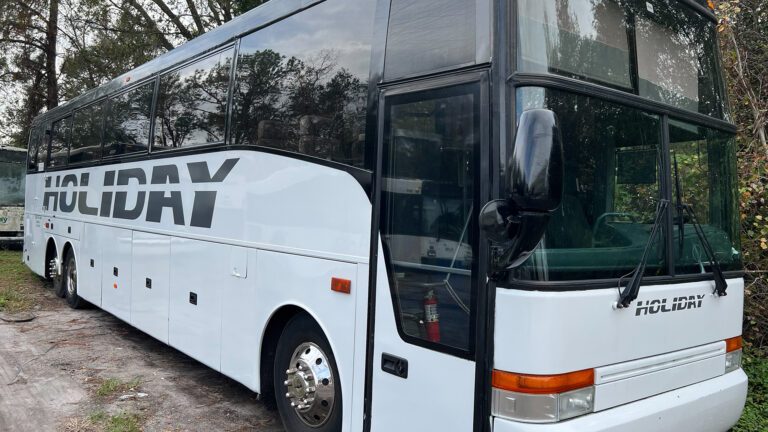
At Holiday Coach Lines, we make that work easy. We’re approved by the US Department of Transportation and the Interstate Commerce Commission, and we hand-pick every driver for safety record and service.
Request a quote today and travel with a team that treats safety as the starting point, not a selling point.
Frequently Asked Questions
How can I check a bus company’s safety record?
Use the FMCSA’s SAFER system and the SMS website. Enter the company’s USDOT or MC number to see operating status, safety rating, inspection history, and crash data. Check that the carrier is authorized for interstate travel and has a satisfactory rating. For intrastate trips, contact the state public utility commission. Always verify insurance coverage and ask the company for its safety rating directly.
What should I ask a charter bus company about driver qualifications?
Ask if drivers hold a current CDL with passenger and air brake endorsements, have passed DOT drug and alcohol testing, and meet medical certification requirements. Inquire about their motor vehicle record review process and hours-of-service training. A reputable company will provide documentation and explain how they monitor driver fatigue and ensure compliance with federal regulations.
How can passengers check a bus before boarding?
Walk around the bus and look for obvious damage, leaks, or worn tires. Inside, check that seat belts are present and functional, emergency exits are clearly marked and unobstructed, and the aisle is free of tripping hazards. Confirm that the driver has a valid CDL and appears alert. If you see anything concerning, report it to the company or the FMCSA before departure.
How often should a charter bus be inspected?
Federal regulations require a pre-trip inspection before every trip and a systematic inspection at least every 30 days for interstate carriers. Many companies perform daily walk-arounds and more thorough monthly checks. Ask the operator for their inspection schedule and review the most recent inspection report. Regular maintenance and prompt repairs are signs of a responsible operation.