Table of Contents
- Choosing the Right Bus Type for Your Group Size
- Charter Bus Rental Cost Estimator: What Drives Your Quote
- Your Charter Bus Booking Checklist: From Quote to Confirmation
- Motorcoach Amenities for Corporate Events and Group Travel
- Insurance, Liability, and Accessibility Requirements
- Logistics Planning: Pickup, Drop-Off, and Itinerary Management
- Common Mistakes When Renting Buses for Large Events
- Frequently Asked Questions
Last Updated: October 1, 2026
Choosing the Right Bus Type for Your Group Size
Renting buses for large events starts with matching the vehicle to your headcount. Get it wrong and you either pay for empty seats or scramble for a second vehicle the week of the event.
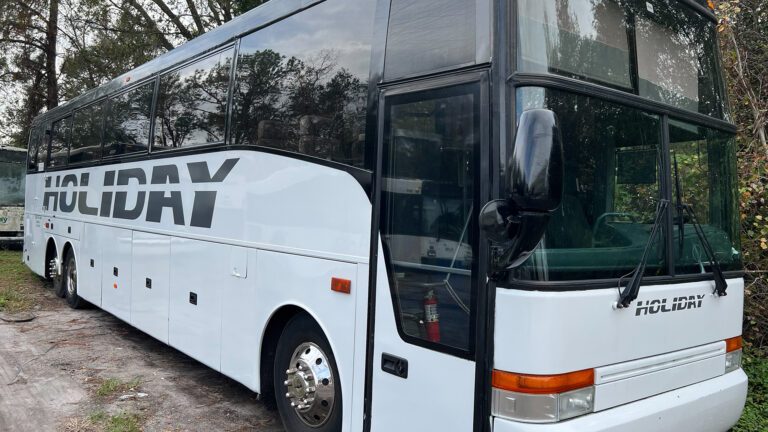
- Motorcoach: The largest standard option, typically seating around 56 passengers with a restroom, luggage bays, and reclining seats. Best for long-distance travel and full-day events.
- Mini bus: Seats roughly 24 to 35 passengers. Useful when a full motorcoach is more space than you need.
- Shuttle bus: Smaller capacity, designed for short, repeated loops between a hotel and a venue.
- School bus: A budget option for youth groups and short trips, with bench seating and no onboard restroom.
Matching Passenger Capacity to Your Event
Start with your confirmed guest count, then add a buffer. A common mistake is booking to the exact number of attendees. Ten to fifteen percent of invited guests typically drive themselves or drop out, but you cannot count on that.
Ask your reservation specialist how many seats are actually usable after luggage. A “56-passenger” motorcoach may hold fewer people comfortably once coolers, instruments, or sports bags take up bay space.
Charter Bus Rental Cost Estimator: What Drives Your Quote
Pricing for group transportation is not a flat rate; it is built from several variables. Understanding them lets you compare quotes fairly and know what you are actually paying for.
How a Quote Is Actually Built
Most operators price a trip one of three ways. Ask which model you are quoted, because the same trip can look cheap under one and expensive under another.
- Hourly with a minimum. Common for local events and shuttles. You are charged for a minimum block of hours (often 4 to 5) plus any time beyond it. The clock usually starts when the driver reports to the yard, not when the first passenger boards.
- Flat rate for a defined trip. Common for point-to-point runs like an airport transfer or a venue-to-hotel loop. The rate assumes a specific route, a specific window, and no detours.
- Per-mile plus hourly. Common for long-distance and multi-day trips. You pay mileage and driver time separately, which is why a route change mid-trip can move the final bill.
Two line items trip up first-time bookers most:
- Deadhead time. The unpaid-for-you but paid-for-by-you drive the bus makes from its yard to your first pickup and back at the end. On a short local trip, deadhead can be a meaningful share of the total. Ask whether it is included or billed.
- Driver hours-of-service limits. Federal rules cap how long a commercial driver can be on duty before a required rest break. On a long event day, that cap, not your itinerary, can determine whether you need a second driver or a second bus.
The Cost Factors, and How to Control Each
| Cost Factor | What It Covers | How to Control It |
|---|---|---|
| Distance and time | Fuel, driver hours, mileage | Consolidate pickup points; avoid detours |
| Vehicle count | One driver and bus per vehicle | Right-size capacity to headcount |
| Date demand | Peak-season fleet scarcity | Book early; travel midweek when possible |
| Amenities | Wi-Fi, chargers, restrooms | Confirm what is standard vs. add-on |
| Wait and overtime | Driver time beyond schedule | Build buffer into your itinerary, not the quote |
| Deadhead | Yard-to-pickup and return miles | Ask if included; choose a closer operator |
Hidden Fees to Watch For
- Fuel surcharges that adjust with gas prices, ask whether the surcharge is fixed at booking or floats
- Driver gratuity, sometimes listed as optional and sometimes expected; confirm the customary range
- Overnight and layover fees when a driver stays with the group, including hotel and per-diem
- Tolls and parking on your route, especially at stadiums and convention centers
- Cleaning fees for excessive mess, and what triggers them
- Late cancellation penalties and how they scale as the event date approaches
When you compare quotes, send every operator the same route, the same schedule, and the same headcount. Quotes built on different assumptions are not comparable, and the cheapest one is often the one that assumed the least.
Because every trip is different, the honest answer to “what will it cost” is: request a quote. A provider that builds quotes around your route, group size, and schedule gives you a number you can hold them to.
Your Charter Bus Booking Checklist: From Quote to Confirmation
A charter bus booking checklist keeps a complex process from slipping through the cracks. Work through it in order, and confirm each item in writing.
- Estimate your guest count with a 10-15% buffer
- Choose a vehicle type that matches capacity and trip length
- Gather 2-3 quotes using the same route and schedule details
- Confirm what is included versus billed separately
- Review the contract terms, including cancellation policy
- Verify insurance and licensing (see the next section)
- Pay the booking deposit to lock your reservation
- Confirm pickup times, locations, and a contact for the day
- Share the itinerary with your group and the driver
- Reconfirm 48 hours before the event
Booking six weeks out for a peak-season event is risky. Popular dates and large vehicles sell out first. If your event falls on a holiday weekend or graduation season, start the process months ahead.
Motorcoach Amenities for Corporate Events and Group Travel
On-board amenities do more than add comfort. For corporate event transportation, they turn travel time into usable time.
Modern motorcoaches commonly include:
- Air conditioning and climate control
- Reclining seats for longer journeys
- Free Wi-Fi so passengers can work or stay connected
- USB chargers at the seats
- Restrooms on full-size coaches
- Overhead storage and luggage bays
Insurance, Liability, and Accessibility Requirements
Two things separate a professional operator from a risky one: proper insurance and genuine accessibility. Both deserve a direct question before you book, and both are areas where most event planners do not know what to ask.
Insurance and Liability Checklist
Asking for proof of insurance is not being difficult, it is what any venue, school district, or corporate risk office will require of you anyway. Ask for a Certificate of Insurance (COI) and read it, not just the cover email.
- Commercial auto liability. This is the coverage that responds if the bus is at fault in a crash. Ask for the per-occurrence and aggregate limits in writing. A common pattern is that institutional clients require limits well above the state minimum, so confirm the operator can meet your organization’s threshold before you sign.
- General liability. Separate from auto coverage, this responds to injuries and property damage that happen off the vehicle, a guest tripping on the steps, for example.
- Certificate holder status. Ask to be named as an additional insured or certificate holder on the policy. That is what gives you standing to file a claim directly rather than waiting on the operator.
- Operating authority. Verify the company holds active operating authority with the Federal Motor Carrier Safety Administration. You can look up a carrier’s authority and safety record in the agency’s public database.
- Driver qualifications. Confirm drivers hold a commercial driver’s license (CDL) with the correct endorsements for the vehicle and any passengers requiring assistance, and that the operator runs pre-employment and random drug and alcohol testing.
- Liability allocation in the contract. Understand who is responsible for delays, damage, and injury, and whether the contract caps the operator’s liability. Read the indemnification clause, not just the cancellation policy.
A COI that lists only the state minimum limits may not satisfy your venue, insurer, or corporate risk team. Get your own organization’s required limits in hand before you request quotes, so you can screen operators on the first call.
Accessibility Requirements
Accessibility is not a last-minute add-on. It requires the right vehicle, enough lead time, and federal law most event planners never think to invoke.
- ADA applies to charter service. Under the Americans with Disabilities Act, private charter operators providing transportation to the public must make accessible vehicles available on request. That means you can ask for a lift-equipped or ramp-equipped bus, and the operator is expected to provide one when given reasonable notice.
- Ask specifically about the vehicle, not the company. A fleet may include accessible vehicles without every vehicle being accessible. Confirm the specific bus assigned to your date has a working lift or ramp and securement positions for wheelchairs and mobility devices.
- Give advance notice. Accessible vehicles are a smaller share of most fleets. The earlier you flag the need, the more likely the right bus is available on your date.
- Check the boarding points, not just the bus. A lift-equipped bus is useless if the pickup location has no step-free path to the curb. Walk your pickup and drop-off points and confirm level, unobstructed access.
- Confirm service animals and mobility aids. Ask how the operator handles service animals and whether passengers may remain in their wheelchairs during travel, since policies vary by vehicle and route.
Logistics Planning: Pickup, Drop-Off, and Itinerary Management
Good transportation planning lives or dies on pickup and drop-off details. The vehicle is only half the job; the schedule is the other half.

Backup Plans and Fleet Availability
Ask what happens if a bus breaks down. A reputable operator has a plan: a replacement vehicle, a maintained fleet, and drivers who know the route.
Common Mistakes When Renting Buses for Large Events
Most problems with event transportation trace back to a handful of avoidable errors. Here are the costliest.
- Booking too late. Peak dates and large vehicles disappear first.
- Right-sizing to the exact headcount. No buffer means no room for error.
- Ignoring the fine print. Cancellation policy, overtime, and gratuity add up.
- Forgetting accessibility. A guest who uses a wheelchair needs a lift-equipped bus, booked in advance.
- Skipping the itinerary. Drivers need a written schedule, not a verbal one.
- Choosing on price alone. The cheapest quote often hides fees or cuts corners on maintenance.
The three things that prevent almost every transportation disaster: book early, build in buffer time, and confirm every cost and accessibility detail in writing before you sign.
Frequently Asked Questions
How far in advance should you book a charter bus for a large event?
For large events with 100 or more guests, book at least three to six months ahead, especially during peak seasons like spring weddings or fall tournaments. Smaller groups may find availability with four to six weeks’ notice, but fleet availability tightens quickly. Renting buses for large events during holidays or major conventions can require even earlier planning. Contact a reservation specialist as soon as your date and headcount are confirmed to lock in your vehicles.
What factors influence the price of renting a bus for an event?
Pricing depends on trip distance, total hours, number of vehicles, date, and season. A charter bus rental cost estimator typically factors in the hourly rate, driver services, fuel surcharges, tolls, parking, and any overnight stays. Amenities like Wi-Fi and USB chargers usually come standard on modern motorcoaches. Request a detailed quote from Holiday Coach Lines so every line item is clear before you commit.
Are there specific insurance requirements for event bus rentals?
Reputable operators carry commercial liability coverage and meet US Department of Transportation safety standards. Ask for a certificate of insurance showing liability limits and confirm the policy covers your event type. Your venue may also require a certificate naming it as an additional insured. A charter bus booking checklist should include verifying insurance, driver qualifications, and vehicle inspection records before signing any contract.
How do I determine the right bus size for my group?
Start with your confirmed headcount, then add a buffer of 5 to 10 percent for last-minute guests. A 57-passenger motorcoach suits large weddings and corporate shuttles, while a mini bus works for groups of 20 to 30. If your group exceeds one vehicle’s capacity, consider multiple buses running the same route. Passenger capacity, luggage space, and pickup logistics all affect the final recommendation.