Last Updated: October 26, 2026
Quick Summary
The best florida charter bus companies are licensed, insured operators that pair clean, well-maintained vehicles with professional drivers and transparent booking terms. Compare operators on licensing and insurance, fleet condition, driver standards, and booking terms rather than choosing the lowest quote, since a low price often hides thin insurance or older coaches.
- Confirm the operator’s US Department of Transportation number and check it against public records.
- Quotes are typically billed garage-to-garage, so a 4-hour event can bill as 6 hours.
- Many operators apply minimum billable periods, commonly 4 or 5 hours on weekends.
- A full motorcoach seats 47 to 56 or more and carries large underfloor luggage bays.
- Holiday Coach Lines is family-owned with more than 138 years of combined industry experience.
Table of Contents
- How to Compare Florida Charter Bus Companies
- Questions to Ask a Charter Bus Company Before You Book
- Charter Bus Safety Checklist: Verify Licensing and Insurance
- What Drives Charter Bus Rental Cost in Florida
- Matching Fleet Options to Your Group Type
- Statewide Service and Booking Timelines for Florida Groups
- Request a Quote from Holiday Coach Lines
- Frequently Asked Questions
How to Compare Florida Charter Bus Companies
Finding the best Florida charter bus companies starts with a simple shift: stop shopping for the lowest quote and compare operators on what decides whether your trip runs smoothly.
Most organizers compare price first and everything else second. That order is backwards.
Here is the comparison framework we recommend:
- Licensing and insurance: Can the operator prove current authority and coverage?
- Fleet condition and capacity: Does the vehicle match your group size, luggage, and accessibility needs?
- Driver standards: How are drivers screened, trained, and scheduled?
Below, we walk through each criterion, the safety checks to run before signing anything, what drives cost, and how to match a vehicle to your group.
Questions to Ask a Charter Bus Company Before You Book
The right questions to ask a charter bus company fall into four buckets: safety, vehicles, pricing, and logistics. Ask before you sign, and get written answers where possible.
Start with safety. Ask whether the operator holds current operating authority and can provide proof of insurance. Federal Motor Carrier Safety Administration maintains public records on carrier authority and safety history, and any reputable operator should be comfortable with you checking.
Next, ask about the vehicle: age, air conditioning, restrooms, Wi-Fi, USB charging, and luggage capacity.
Then move to money and logistics:
- Is the quote all-inclusive, or are fuel surcharges, tolls, driver gratuity, and overnight fees extra?
- What is the deposit, and when is the balance due?
- What is the cancellation policy, and what happens if your event date changes?
That last question matters more than most organizers realize. A good operator has a spare vehicle plan. A weak one leaves you stranded.
Charter Bus Safety Checklist: Verify Licensing and Insurance
A charter bus safety checklist should confirm four things before you book: valid operating authority, adequate insurance, a clean maintenance record, and vetted drivers. Run through this list with every operator you consider.
- Confirm the operator’s US Department of Transportation number and check it against public records
- Request a certificate of insurance and confirm the coverage limits in writing
- Ask how often vehicles are inspected and maintained, and request the schedule
For a detailed walkthrough of each step, see our guide on how to verify bus safety.
This is where price differences make sense: operators investing in newer coaches, scheduled maintenance, and careful driver screening carry higher costs that show up in the quote, usually money well spent when you are responsible for a group.
What Drives Charter Bus Rental Cost in Florida
Most charter bus quote pages say price depends on distance, duration, and vehicle size, then stop. This section breaks down how operators actually build a price, which line items to expect, and how to spot a low quote that will grow before your trip does.
The five pricing inputs
Every charter bus quote is built from the same five inputs, even when operators present them differently:
- Vehicle class and capacity. A minibus, mid-size coach, and full 56-passenger motorcoach carry different rates because they cost different amounts to own, insure, fuel, and maintain. A 24-passenger minibus quote and a 56-passenger motorcoach quote are not comparable even for the same route.
- Billable time, not just drive time. Operators typically bill garage-to-garage, so the clock starts when the coach leaves the yard. A 4-hour event with a 45-minute deadhead each way is often billed as 6 hours. Ask which basis the quote uses.
- Mileage or route scope. Local shuttles are often priced hourly with a mileage allowance; long-distance and multi-day trips are usually priced by the day plus mileage or a flat route rate. Ask which method applies and what happens if your route changes.
- Driver time and duty limits. Multi-day trips require driver lodging, per diem, and federal hours-of-service compliance, which can require a second driver on long runs. Those costs should appear as separate lines, not folded into the base rate.
- Season and lead time. Peak wedding weekends, conventions, graduation season, and holiday travel tighten availability. A quote two weeks out for a peak Saturday may carry a higher rate or minimum-hour requirement than the same trip booked two months ahead.
Line items to expect on an itemized quote
A transparent quote separates the base charter rate from pass-through costs. Look for these lines:
- Base charter rate (hourly, daily, or flat route)
- Driver gratuity, often suggested at a percentage of the base rate; confirm whether it is included or discretionary
- Fuel surcharge, some operators include it, some add it; ask which
A quote that is dramatically lower than the others is usually lower for a reason: older coaches, thinner insurance, a driver pool that is not carefully screened, or fees that appear later. Compare itemized quotes side by side, not just the bottom-line number.
Minimum rental periods and how they affect short trips
Many operators apply a minimum billable period, commonly 4 or 5 hours on weekends and higher on peak dates. That is why a two-hour wedding shuttle can price close to a half-day charter. If your event is short, ask about the minimum before assuming the hourly rate applies.
How to compare two quotes fairly
Put both quotes in the same format before you decide:
- Confirm both use the same billable-time basis (garage-to-garage vs. pickup-to-drop-off).
- Confirm both include or exclude gratuity, fuel surcharge, tolls, and parking the same way.
- Confirm both use the same vehicle class and model year range.
- Confirm both state the cancellation, change, and wait-time terms in writing.
Once normalized, the real price difference usually reflects fleet age, insurance limits, and driver quality, the factors that determine whether your trip runs on time. For a deeper walkthrough, see our breakdown of charter bus cost in Florida.
Matching Fleet Options to Your Group Type
The right vehicle depends on group size, trip length, luggage volume, and accessibility needs, not just headcount. A church group and a sports team may both fit a mid-size coach, but the team needs cargo space the church group does not.

Vehicle classes and realistic capacity
Charter fleets generally fall into four classes. Capacity figures below are typical ranges, not guarantees, always confirm the exact seat count and floor plan for the specific vehicle assigned to your trip.
| Vehicle class | Typical seated capacity | Luggage | Best for |
|---|---|---|---|
| Shuttle van or cutaway | 10-24 | Limited; often rear cargo only | Airport transfers, small social groups, short local runs |
| Minibus | 25-35 | Moderate underfloor or rear storage | Church groups, small corporate teams, local events |
| Mid-size coach | 36-47 | Good underfloor capacity | Corporate travel, regional sports teams, wedding shuttles |
| Full motorcoach | 47-56+ | Large underfloor bays | Multi-day tours, large weddings, full sports teams |
A common planning rule is to leave a few seats open for guides, chaperones, or last-minute additions. A group of 52 squeezed into a 56-seat coach with full luggage is tighter than the seat count suggests.
The luggage math most groups forget
Seat count and luggage capacity are separate constraints. A full motorcoach typically has two to four underfloor bays, and a rule of thumb is roughly one large suitcase per passenger plus carry-ons for a multi-day trip. Sports teams should add equipment bags, coolers, and training gear, which consume bay space fast. If you travel with instruments, display materials, or mobility equipment, give the operator dimensions and counts at quote time.
Accessibility and specialized passenger needs
Not every coach is equipped for wheelchair users or passengers with mobility limitations. If anyone in your group uses a wheelchair, walker, or scooter, raise it at booking, not on the day of the trip. Ask specifically:
- Does the assigned vehicle have a wheelchair lift or ramp, and what is its rated capacity?
- How many wheelchair securement positions are available, and do they reduce seated capacity?
- Can the driver provide boarding assistance, and is that included or an extra charge?
Accessible vehicles are a smaller share of most fleets, so book earlier than you would for a standard coach. Confirm the accessible vehicle in writing on the reservation.
Amenities and the trade-offs behind them
Wi-Fi, USB charging, restrooms, reclining seats, and overhead monitors are common on full motorcoaches and less common on minibuses. Two trade-offs matter:
- Restrooms take up space and reduce seated capacity on some floor plans. On long routes they are worth it; on a two-hour shuttle they may not be.
- Wi-Fi quality varies by vehicle and route. Treat it as a convenience, not a guarantee, and confirm whether it is included on the specific coach assigned to your trip.
Matching vehicle to trip length
For a short local shuttle, a minibus or shuttle van is usually most cost-efficient. For a full-day event with multiple pickup points, a mid-size coach balances capacity and maneuverability.
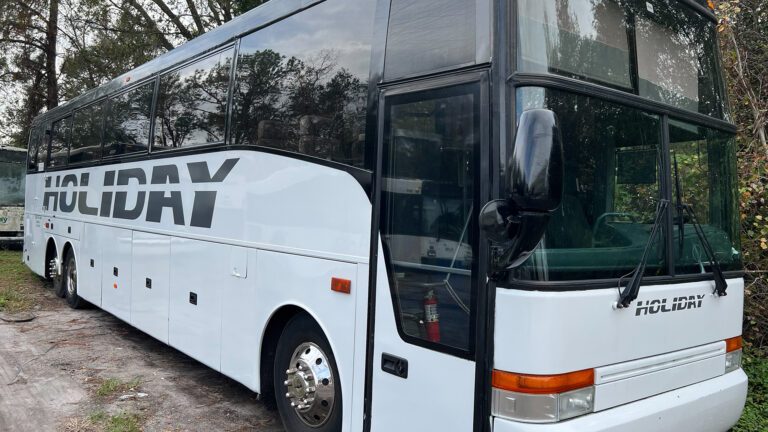
For help choosing between vehicle classes, see our guide to choosing the right motor coach. Our own fleet centers on motorcoaches with 57 reclining seats, air conditioning, free Wi-Fi, and USB chargers, which suits most mid-size and large groups well.
Statewide Service and Booking Timelines for Florida Groups
Booking timelines matter more than most organizers expect. For peak-season events, reserve several weeks to a few months ahead, and earlier for large groups needing multiple coaches.
Statewide coverage is the other piece. A good operator serves pickups from major metros to smaller cities and can coordinate multi-stop routes for out-of-town guests.
If you are still deciding when to lock in your date, our article on how to book a charter bus at the right time walks through the timing trade-offs.
Request a Quote from Holiday Coach Lines
Holiday Coach Lines is a family-owned and operated provider of charter bus services throughout Florida, backed by more than 138 years of combined industry experience.
Our drivers are hand-picked for safety records and customer service, and we hold our vehicles to high standards of maintenance and cleanliness.
Ready to compare options for your dates? Request a free charter bus quote and our team will walk you through vehicle options, availability, and booking terms.
Frequently Asked Questions
How much does it cost to rent a charter bus in Florida?
Charter bus rental cost depends on trip distance, vehicle size, date, and how many hours you need the bus. A short local shuttle for a small group costs less than a multi-day motorcoach trip with overnight stays. Most companies quote per vehicle, not per passenger, so filling seats lowers the per-person price. Ask for a written quote that lists the base rate, driver time, fuel surcharges, and any overnight fees so you can compare bids line by line.
What should I look for when choosing a Florida charter bus company?
Start with operating authority from the Federal Motor Carrier Safety Administration and a current insurance certificate. Check the carrier’s safety rating and out-of-service history in the FMCSA database. Then confirm driver screening, vehicle age, maintenance schedules, and whether the company carries its own backup vehicles. Read recent customer reviews for on-time performance and how the company handled problems. A provider that answers these questions openly and in writing is a safer bet than one that dodges them.
How far in advance should I book a charter bus in Florida?
For weddings, conventions, and peak-season sports travel, book two to six months ahead to secure the right vehicle size and date. Six weeks is usually workable for corporate trips and smaller outings if you are flexible on pickup times. Last-minute requests are possible when a company has idle buses, but choices shrink and rates rise. If your event falls during a busy period, reserve early and confirm the cancellation terms in writing.
Do Florida charter bus companies provide wedding and event transportation?
Yes. Most full-service operators run wedding shuttles, guest transfers between hotels and venues, and private event transportation. Ask whether the company provides a dedicated coordinator, how many pickup points it can handle, and whether it offers a continuous shuttle loop or fixed departure times. For large weddings, confirm the backup vehicle plan and get the driver’s contact information in advance so your planner can reach someone on the day.
Comparing Florida charter bus companies comes down to asking better questions before you book. If you want an operator that puts safety, clean coaches, and professional drivers first, Holiday Coach Lines is ready to help. Get started with Holiday Coach Lines and request a quote for your group today.