Last Updated: November 19, 2026
Quick Summary
The best group travel tips start with a written countdown checklist: confirm dates and destination 12 weeks out, set the shared budget by 10 weeks, and book transport and accommodation by 8 weeks. Agree on trip goals, a single per-person budget, and payment deadlines before anything is booked.
- One organizer owns the master checklist, and a named tiebreaker settles disputes.
- Book transport and accommodation 8 weeks out, after dates and budget are set.
- Split shared costs evenly by headcount and let travelers pay optional costs individually.
- Confirm pickup points with physical addresses, rest stops, and cancellation cutoffs in writing.
- Set one group chat, a daily meeting point, and a buddy system before departure.
Table of Contents
- Start With a Group Trip Planning Checklist
- Agree on Trip Goals, Budget, and Travel Style First
- Use a Group Trip Planning Template to Assign Roles
- Book Transportation Early and Coordinate the Whole Route
- Make Long Charter Bus Rides Comfortable for Everyone
- Set Communication Rules and Contingency Plans
- Traveling With a Group of Friends Without the Friction
- Request a Quote for Your Group’s Motorcoach
- Frequently Asked Questions
Start With a Group Trip Planning Checklist
Long distance group travel tips work best when they start with a written plan, not a group chat. The most reliable approach is a group trip planning checklist that runs on a countdown, so nothing gets decided at the last minute.
Below, we’ll show you how to plan a long trip without losing your mind or your travelers.
Here’s the short version of what separates a smooth trip from a stressful one:
- One organizer holds the master checklist
- Money rules get agreed before anything is booked
- Transport is locked in early
The 12-Week Countdown for Large Groups
Total Time: 12 weeks of prep
Difficulty: Beginner
A group trip planning template turns a vague idea into dated tasks. Here is the timeline we recommend for large groups:
| When | Task | Who Owns It |
|---|---|---|
| 12 weeks out | Confirm dates, destination, trip purpose | Organizer |
| 10 weeks out | Set the shared budget and payment deadlines | Treasurer |
| 8 weeks out | Book transport and accommodation | Logistics lead |
| 6 weeks out | Collect deposits and confirm headcount | Treasurer |
| 4 weeks out | Share the itinerary and meeting points | Organizer |
| 2 weeks out | Confirm accessibility and health needs | Point person |
| 1 week out | Send final schedule and contact list | Organizer |
Watch out: the biggest mistake is booking transport before the headcount is firm. A group that grows by ten people after the deposit deadline forces a scramble for a bigger vehicle.
Agree on Trip Goals, Budget, and Travel Style First
Conflict on group trips rarely starts on the road. It starts when four people assume four different things about the trip. Budget talks often stop at setting a number. The fuller picture also covers how the number gets set, who holds the money, and what happens when participation is uneven.
Settle three questions before you book anything:
- What is the trip for? A wedding, a tournament, a church outing, and a sightseeing weekend need different plans, different pacing, and different budgets.
- What is the total budget per person? Set one shared number, not a range. A range invites everyone to assume the low end.
- What travel style does the group want? Packed sightseeing or slow and relaxed? Ask people to rank a few sample days rather than describe their preference in the abstract.
Turn the Budget Into a Payment Schedule
A single per-person figure is not a plan. Break it into dated obligations so nobody is surprised at the end:
- Deposit: a fixed amount per traveler, due at booking, non-refundable once the vehicle or rooms are held.
- Second payment: due at the headcount-confirmation date, which is also the last date to add or drop travelers without penalty.
- Final balance: due before departure, with a written cutoff for cancellations.
Publish those three dates in the same document as the itinerary. A common pattern is to collect deposits through one treasurer rather than having each traveler pay the vendor separately, because a single ledger makes refunds and reimbursements traceable.
Handle Unequal Participation Up Front
Long-distance group trips almost always have uneven participation: some travelers join only part of the route, some bring a plus-one, some opt out of a paid activity. Decide the rules before money moves:
- Shared costs (transport, lodging) split evenly by headcount, regardless of who uses what.
- Optional costs (tickets, meals, excursions) paid individually at the time of booking.
- A written refund rule for anyone who drops after the deposit deadline.
Watch out: if the group agrees to “split everything” without defining which costs are shared, the treasurer ends up chasing reimbursements for weeks after the trip.
For groups weighing transport options, our guide on why chartering a bus is easier than flying for group travel lays out the comparison, and the cost differences feed directly back into the per-person number.
Use a Group Trip Planning Template to Assign Roles
One person cannot run a long trip alone. Split the work into clear roles, and put each role in a shared group trip planning template everyone can open.
- Organizer: owns the checklist and final calls
- Treasurer: tracks shared expenses and payment deadlines
- Transport lead: handles booking and the route
This is where most guides get it wrong. They tell you to “communicate well” without saying who decides what. Name a tiebreaker before the trip, usually the organizer, and decisions stop dragging.
Book Transportation Early and Coordinate the Whole Route
Transport is the piece groups book last and regret most. Book it early, and book the whole route, not just the departure. For a long-distance trip, the route is a chain of handoffs, and every handoff is a place where the group can fragment. Keeping those handoffs aligned also means knowing how to coordinate flights and hotels around the same arrival times and meeting points.
Compare Modes on the Trade-Offs That Matter to Groups
Each mode has its own weak point. Plan around it rather than assuming one is best.
- Charter bus: easiest for large groups, since everyone stays together. The trade-off is schedule rigidity, the vehicle and driver are yours for the day, so the itinerary has to fit the booking window.
- Flight: fastest over long distances, but adds airport transfers at both ends, baggage fees and rules, and missed-connection risk. A group of twenty moving through security is a different operation than a group of four.
- Train: comfortable and city-center to city-center, but limited routes and fixed schedules. Group seating is not guaranteed unless it is reserved as a block.
For a large group, the fewer handoffs between modes, the fewer chances for someone to get separated. If the trip requires a connection, build a buffer into the schedule rather than booking the tightest possible transfer.
Lock the Route Details Before You Sign
For a long-distance trip, confirm in writing:
- The pickup point and time for every stop, with a physical address, not a landmark
- Where luggage and equipment load, and who handles the loading
- Rest stops along the way, including how long the group has at each
If you’re arranging a motorcoach for a group, our guide to chartering a motor coach for group trips walks through the booking steps. The U.S. Department of Transportation publishes consumer guidance on charter bus safety you can check before you sign.
Plan for Delays, Missed Connections, and Separation
Long-distance trips create coordination risks that short trips do not. Build the contingency into the plan before departure:
- A backup meeting point at every major stop, written down and shared, in case the group splits.
- A communication procedure: one group chat for updates, one designated caller who contacts the driver or vendor, and a rule that everyone checks the chat at each stop.
- A separation protocol: if someone is missing at departure time, the group waits at the vehicle while the organizer and one other person search, rather than everyone scattering.
Watch out: assuming phone service will cover a separation is the most common failure. Dead zones and crowded venues break that assumption, which is why the written meeting point matters more than the group chat.
If a vehicle breaks down, the first few minutes decide how the day goes. Our guide on what to do if your bus breaks down gives your group a step-by-step playbook for securing the scene and getting a replacement fast.
Make Long Charter Bus Rides Comfortable for Everyone
Comfort on long charter bus rides comes down to three things: a good seat, working power, and a plan for breaks.
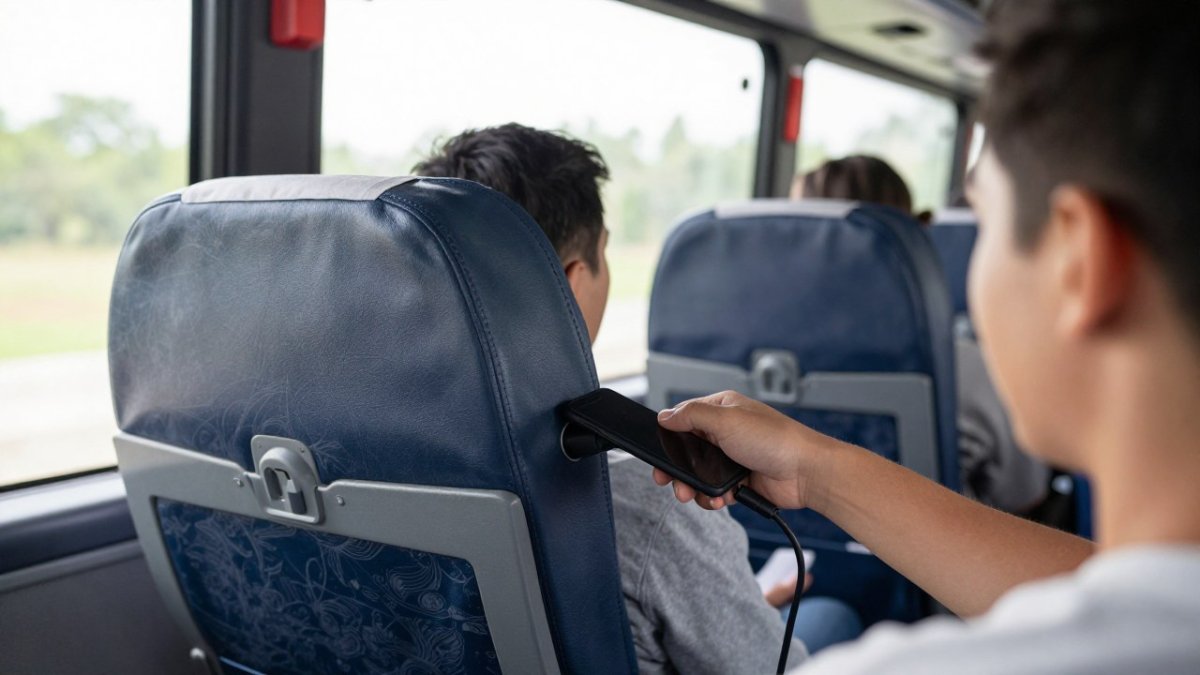
Our motorcoaches carry 57 reclining seats, air conditioning, free Wi-Fi, and USB chargers. The rest is on the group:
- Pack a light layer, since cabin temperatures vary
- Bring snacks and water for the stretches between stops
- Agree on quiet hours so people can sleep
Travelers who want the full list can compare motorcoach amenities that make long trips comfortable before they pack.
Set Communication Rules and Contingency Plans
A group that communicates well before the trip handles problems faster during it. Set the rules early and write them down.
- One group chat for updates, not five
- A daily meeting point and time posted each morning
- A buddy system so no one travels alone
Then plan for what can go wrong. Delays, missed connections, and separation all happen. A common mistake is assuming phone service will cover it, and it may not always.
Watch out: if a vehicle breaks down, the first few minutes decide how the day goes.
Traveling With a Group of Friends Without the Friction
Traveling with a group of friends gets harder as the group gets bigger and the trip gets longer. The fix is simple: protect personal space and build in free time.
Not everyone wants the same dinner, the same pace, or the same amount of togetherness. That’s normal. Plan for it:
- Schedule group activities for part of each day, not all of it
- Let people opt out of any activity without a debate
- Set meal plans that allow separate checks
Bonding happens on the trip, but it happens best when nobody feels trapped. Give people room, and the group dynamics stay healthy.
Request a Quote for Your Group’s Motorcoach
A long trip runs on good planning and one reliable vehicle.
At Holiday Coach Lines, we’re family owned and operated, with more than 138 years of combined industry experience.
We work with groups of many sizes, from church outings to weddings and sports teams.
Get started with Holiday Coach Lines and give your group a trip that runs on time, from the first pickup to the last drop-off. Visit our reservations page to request a quote today.
Planning a long trip for a group means juggling budgets, roles, routes, and people who all want something slightly different.
Frequently Asked Questions
How do you plan a long-distance trip for a group?
Start with a group trip planning checklist about 12 weeks out: confirm dates and destination, collect everyone’s budget comfort zone, assign a trip organizer and a money point person, then book transportation and accommodation before prices climb. Share a group trip planning template so tasks, payment deadlines, and room assignments live in one place. Build the itinerary with fixed anchors (flights, tours, event times) and leave open blocks for free time. Confirm the meeting point and a communication channel before anyone packs.
How can a group keep long-distance travel costs manageable?
Agree on a shared budget before booking anything, and collect deposits through one person or a shared expense app so payment deadlines are visible to all. Booking group transportation such as a charter bus lets the group share one vehicle rather than paying for several cars. Choose accommodation with room sharing to lower nightly rates, and plan a mix of group activities and budget-friendly free time. Keep a small contingency fund for delays or missed connections.
What should you pack for a long charter bus ride with a group?
Pack a small carry-on with layers, a refillable water bottle, snacks, motion-sickness remedies, and any medication in your day bag rather than the luggage hold. Bring a portable charger and cable for the bus’s USB outlets, plus headphones for personal entertainment. Wear comfortable shoes and loose clothing for the long bus ride. If you are traveling with a group of friends, agree on shared items like card games or a speaker so the group activities stay organized and courtesy toward other passengers holds up.
How do you handle different schedules and preferences on a group trip?
Set a trip vision up front, then let people opt in or out of specific group activities instead of requiring full attendance. Publish a daily travel schedule with clear meeting points and departure times, and build in free time so different interests and energy levels get room. Assign a buddy system for anyone splitting off, and use one group chat for updates. For accessibility or health needs, ask privately and early so transportation and accommodation can be arranged without last-minute scrambling.