Last Updated: November 5, 2026
Quick Summary
If your bus breaks down, steer as far onto the right shoulder as possible, turn on the hazard lights, and count every passenger before anyone moves. Stay aboard unless there is fire, smoke, or a fuel leak, and call 911 for immediate hazards or dispatch for a mechanical breakdown.
- Set the parking brake and keep the engine off if you smell fuel.
- Place reflective triangles behind the coach, starting close and working back.
- Move the group at least 100 feet away and upwind if fire or smoke appears.
- Call 911 first for fire, smoke, injury, or a coach stopped in a live lane.
- Give passengers an update every 20 to 30 minutes even when there is nothing new.
Table of Contents
- The First Five Minutes: Stay Calm and Secure the Scene
- What to Do If a Bus Breaks Down on the Highway
- Charter Bus Emergency Procedures: Who Does What
- Stay Aboard or Evacuate? Deciding with Vulnerable Passengers in Mind
- What Happens If a Charter Bus Breaks Down: Calling for Help and Managing Passengers
- Bus Replacement After a Breakdown: How the Backup Plan Works
- After the Incident: Reports, Follow-Up, and Preventing a Repeat
- Booking Group Transportation with a Backup Plan Built In
- Frequently Asked Questions
The First Five Minutes: Stay Calm and Secure the Scene
A bus breakdown on a highway is a roadside emergency, and the first five minutes set the tone for everything that follows. A well-run charter operator trains its drivers for this exact moment: stop safely, get visible, and account for every passenger before anything else.
What to do if a bus breaks down starts with three actions. Steer the vehicle as far onto the right shoulder as possible. Turn on the hazard lights. Then take a breath and count heads.
Panic spreads faster than any mechanical problem. A calm driver who speaks clearly helps keep a group from turning a delay into a danger.
Here is the short version of those first five minutes:
- Grip the wheel and slow down gradually, never brake hard
- Pull as far right as the shoulder allows
- Switch on hazard lights immediately
The Federal Motor Carrier Safety Administration sets the inspection and safety rules that charter operators must follow, which is why a well-run company already has a breakdown plan on paper before the wheels ever turn.
What to Do If a Bus Breaks Down on the Highway
Highway breakdowns carry more risk than city ones because traffic moves fast and the shoulder is narrow. The priority shifts from fixing the bus to protecting the people inside it.
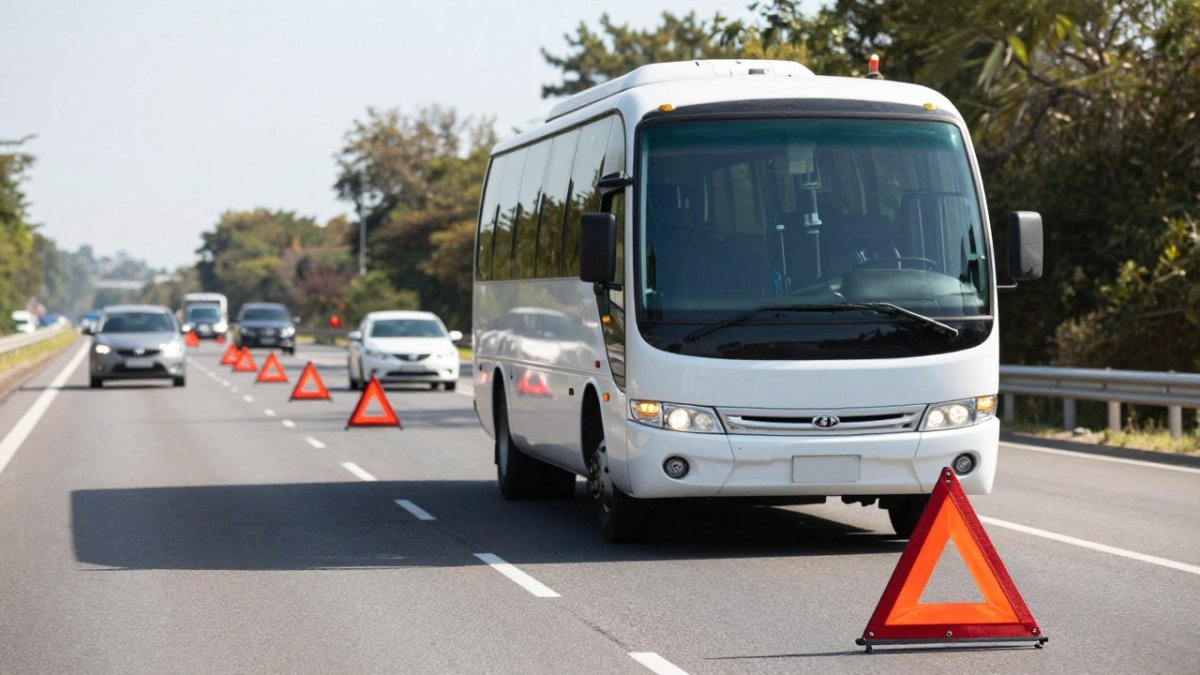
Moving to a Safe Location and Setting Up Warning Devices
Get the coach onto the widest part of the right shoulder, away from a curve or crest if you can. Put the transmission in park, set the brake, and leave the hazard lights flashing.
Then make the bus visible. Warning devices matter more than most people think.
- Place reflective triangles behind the coach, starting close and working back
- On a highway, put the first triangle well behind the vehicle so approaching traffic sees it early
- Keep your body facing traffic and never turn your back on the lane
Checking for Smoke, Fire, or Fluid Leaks Before You Exit
Before anyone opens a door, check for hazards. Smoke, fire, or a strong fuel smell changes the plan completely.
Look and listen for:
- Smoke from the engine compartment or wheel wells
- Flames or heat near the brakes
- A puddle of fluid under the coach, especially fuel
If you see fire or heavy smoke, evacuate immediately and move everyone well away from the vehicle. If the coach is simply stalled with no hazards, keep passengers aboard. The cabin is usually safer than the shoulder.
Charter Bus Emergency Procedures: Who Does What
Clear roles prevent chaos. Charter bus emergency procedures work best when the driver, passengers, and trip organizer each know their job before the trip begins.
Driver, Passenger, and Trip Organizer Responsibilities
The driver owns the scene. That means securing the vehicle, calling dispatch, and deciding whether to evacuate.
Passengers have one job: stay calm, stay seated unless told otherwise, and follow instructions. The trip organizer becomes the bridge between the driver and the group.
| Role | Main Job | Key Action |
|---|---|---|
| Driver | Secure the scene and call for help | Hazards on, triangles out, dispatch called |
| Trip organizer | Keep the group informed | Share updates, manage questions calmly |
| Passengers | Stay safe and accounted for | Remain seated, report any missing person |
The organizer should also keep a head count and note anyone with medical needs. That information goes straight to the driver.
Stay Aboard or Evacuate? Deciding with Vulnerable Passengers in Mind
Staying aboard is the default, but it is a decision, not a reflex. Treat the coach as shelter only while it is off the travel lane, upright, and free of fire, smoke, or a fuel leak. The moment any of those conditions fails, the bus becomes the hazard and the group needs to move.
Use this hazard-based test before you open a door:
- Fire, smoke, or visible flames anywhere on the coach: evacuate immediately, even if the bus is on a safe shoulder. Move the group at least 100 feet away and upwind, and keep them off the shoulder edge.
- Strong fuel smell or a spreading puddle under the coach: evacuate and keep ignition sources, including phones held close to a spill, away from the area.
- Bus stopped in a live lane or on a blind curve or crest: evacuate to the far side of the guardrail or beyond the shoulder, never into the adjacent lane, and only when traffic allows a safe gap.
Choosing a Safe Refuge Location
Where you gather matters as much as whether you evacuate. A common pattern is to move people to the far side of a guardrail, up a gentle slope away from the roadway, or behind a solid barrier, and then keep them there until a first responder or dispatcher confirms the scene is secure.
Watch out: an evacuation that sends passengers into a live traffic lane causes more injuries than the breakdown itself, so if there is no safe refuge, staying belted aboard and calling 911 is the better call.
Accessible Evacuation for Vulnerable Passengers
Older adults, young children, and passengers who use wheelchairs, walkers, or canes need a plan made before the trip, not during the crisis. A pre-trip seating chart noting who needs assistance, paired with an assigned travel companion for each person, can help shorten evacuation time.
Plan and execute it this way:
- Identify passengers who need assistance at booking and again at boarding, and seat them near the main door or the accessible exit.
- Assign one helper per person who needs assistance, and brief the helpers before departure on how to support a transfer without lifting alone.
- Use the lift or ramp for mobility devices when the coach is level and the exit is clear; if the lift is inoperable, use the emergency exit with two helpers and follow the device manufacturer’s tie-down release procedure.
Rushing an evacuation causes injuries. Slow, directed, and counted beats fast and chaotic every time.
What Happens If a Charter Bus Breaks Down: Calling for Help and Managing Passengers
What happens if a charter bus breaks down depends on how fast and how clearly the driver communicates. One call to dispatch sets the whole recovery in motion, and one clear message to passengers keeps a delay from becoming a disturbance.
What to Tell 911 Versus Dispatch
Call 911 first when there is fire, smoke, injury, a passenger in medical distress, the coach is stopped in a live lane, or a hazardous material spill is possible. Once dispatch has the details of the breakdown and the bus’s location, clear communication can help speed up faster roadside repair and keep the replacement plan moving.
Give 911 the short version, in this order:
- Location: highway name or route number, direction of travel, nearest mile marker or exit, and the nearest cross street if you know it.
- What is happening: fire, smoke, injury, or a bus blocking a lane.
- People on board: total passenger count and how many need medical help.
Give dispatch the fuller picture, adding:
- The mechanical symptom, including any warning light, odd sound, or loss of power.
- Whether the coach is fully off the road or partly in a lane.
- Passenger count, any medical needs, and whether anyone is unaccounted for.
Watch out: reading a location from a map app while standing on a shoulder is a common way to give the wrong mile marker, so read the marker sign itself or use the highway’s posted exit number whenever one is visible.
Passenger Communication During the Delay
Silence is what turns a two-hour delay into a complaint. Set a cadence and stick to it: an announcement within the first five minutes, then an update every 20 to 30 minutes even when there is nothing new, and an immediate update when the replacement bus or tow is dispatched and again when it is 15 minutes out.
A sample message the trip organizer can read aloud covers four things:
“The coach has a mechanical issue and we are safely off the road. No one is hurt. Dispatch has been called and a replacement bus is being arranged. We will update you every 20 minutes. If you have a medical need or an urgent call to make, tell me now and I will get it to the driver.”
Keep the group informed about the expected wait, the replacement transport plan, and how to report urgent needs. Collect urgent needs, such as medication, a restroom, or a time-sensitive connection, on a single list and hand it to the driver so dispatch can factor it into the recovery plan.
Bus Replacement After a Breakdown: How the Backup Plan Works
A real backup plan means a replacement bus, not an apology.
Ask any operator three questions before you book:
- How fast can a rescue bus reach us?
- Is roadside assistance included, or billed extra?
- What happens to our schedule if the replacement takes hours?
A charter operator’s dispatch team should coordinate the replacement vehicle and keep the trip organizer updated throughout. That coordination is what separates a delay from a disaster.
Before you sign, read what a backup vehicle policy should cover, from replacement timelines to contract terms, so there are no surprises on the day.
After the Incident: Reports, Follow-Up, and Preventing a Repeat
Every breakdown leaves a paper trail, and that trail protects everyone. A driver typically files an incident report covering the time, location, mechanical issue, and how passengers were handled.
The operator then reviews maintenance records. A breakdown is often a signal that a part was missed or a schedule slipped.
Prevention comes down to routine:
- Regular vehicle inspections before every trip
- Logged maintenance with no skipped items
- Driver reports on any warning light or odd sound
Understanding why charter bus fleet maintenance matters shows how inspections and records stop small issues from becoming roadside emergencies.
Booking Group Transportation with a Backup Plan Built In
The best time to think about a breakdown is before you book. Ask about the backup plan up front, then confirm the operator’s safety record.
Start with a step-by-step way to verify bus safety so you know exactly what to check.
When you are ready to plan, contact us to request a quote and lock in group transportation with a backup plan you can trust.
Frequently Asked Questions
Should passengers get off the bus if it breaks down?
Usually no. On a highway or busy road, staying aboard with seatbelts on is safer than standing on the shoulder where traffic passes at speed. Exit only if there is smoke, fire, a fuel smell, or another immediate hazard, and then use the door or emergency exits on the side away from traffic. The driver makes the call after checking conditions, and passengers should follow that instruction rather than stepping out on their own.
Who should you contact if your charter bus breaks down?
The driver contacts the charter company’s dispatch or control center first, since that is who arranges a roadside repair, tow truck, or replacement bus. If anyone is injured or the vehicle is blocking a lane, call 911. Trip organizers should stay in touch with their own group and the venue while the driver handles the company. Passengers should avoid calling tow services independently, which can slow down the company’s own response.
How long does it take to get a replacement bus?
Wait time depends on fleet availability, distance, and traffic. A local operator may have a spare coach at the garage ready to dispatch, which can mean a wait measured in hours rather than minutes. Ask dispatch for an estimated arrival time and a callback point so you can update your group.
What should the trip organizer do while waiting for help?
Keep a passenger count, share the vehicle location and direction of travel with dispatch, and update the venue or receiving group on the delay. Let passengers know what is happening and roughly when to expect news, because silence causes more anxiety than a delay itself. If the group includes older adults, children, or anyone with mobility needs, check on them and keep them comfortable aboard the coach until the driver says otherwise.
A breakdown should never leave your group stranded and guessing. Holiday Coach Lines builds every trip around safety, maintenance, and a real replacement plan, backed by 138 years of combined experience and a fleet kept to the highest standards. Get started with Holiday Coach Lines and travel with a team that has a plan for the unexpected.