Last Updated: October 30, 2026
Quick Summary
Charter bus maintenance is the scheduled inspection, repair, and record-keeping program that keeps every coach road-ready before it carries a single passenger. A bus that misses a brake check can cancel a wedding shuttle or strand a team on the road, which is why maintenance matters more in charter service than in almost any other kind of transport.
- A daily walk-around checks tires, brakes, lights, fluids, emergency exits, and fire extinguisher before dispatch.
- Mileage-based service commonly includes oil and filter service every 6,000 to 10,000 miles.
- Any out-of-service defect removes the coach from service immediately, with no exceptions for a sold-out trip.
- Schedule major service in shoulder weeks just before peak travel, not during it.
- Ask whether an operator can produce service history for the specific coach assigned to your trip.
Table of Contents
- Why Charter Bus Fleet Maintenance Decides Whether Your Trip Happens
- The Bus Fleet Maintenance Checklist That Prevents Roadside Breakdowns
- Charter Bus Inspection Requirements Every Operator Must Meet
- Building a Bus Maintenance Schedule Around Your Trip Calendar
- How Bus Maintenance Records Prove Safety and Compliance
- What Poor Charter Bus Maintenance Costs You in Dollars and Downtime
- Requesting a Quote From Holiday Coach Lines
- Frequently Asked Questions
Why Charter Bus Fleet Maintenance Decides Whether Your Trip Happens
Charter bus maintenance is the scheduled inspection, repair, and record-keeping program that keeps every coach road-ready before it carries a single passenger.
Here is the part most people miss.
Group travel has no Plan B built in. A family car that breaks down affects one household.
Below, we explain what a maintenance program looks like, from the daily checklist to the paperwork that proves it happened.
The Bus Fleet Maintenance Checklist That Prevents Roadside Breakdowns
A bus fleet maintenance checklist is a written list of inspections and service tasks performed on a fixed schedule, signed off by the person who did the work.

Comprehensive inspections must extend to accessibility features, as rigorous specialized bus maintenance remains essential for ensuring that every passenger experiences a safe and reliable journey regardless of their mobility needs.
Most generic fleet checklists are written for trucks or school buses. A charter coach carries a different load, runs different duty cycles, and has passenger-facing systems such as climate control, Wi-Fi, and USB charging that a freight checklist never touches.
Daily walk-around (every day the coach is dispatched)
- Tires: tread depth, sidewall condition, and pressure checked cold against the placard
- Brakes: air pressure build-up and loss test, parking brake hold
- Lights: headlights, turn signals, brake lights, marker lights, hazard flashers
- Fluids: engine oil, coolant, windshield washer, diesel exhaust fluid where equipped
- Mirrors, wipers, and horn
Pre-trip inspection (before every booked trip)
A pre-trip inspection is the one that saves trips. A driver who walks the coach before departure can catch a soft tire or a burned-out marker light while the fix is still cheap. Beyond the daily items, a pre-trip inspection typically adds:
- Interior: seats secure, aisle clear, seat belts functional where equipped
- Climate control: heat and air conditioning both operating
- Passenger amenities: Wi-Fi, USB ports, PA system, and destination sign
- Wheelchair lift or ramp: full cycle test if equipped
- Luggage bay: latches, lights, and floor condition
Mileage-based service intervals
Exact intervals come from the coach manufacturer’s service manual, and they vary by engine, transmission, and duty cycle. A common pattern for over-the-road motorcoaches is:
- Every 6,000-10,000 miles: oil and filter service, chassis lubrication
- Every 12,000-15,000 miles: air filter, fuel filter, and coolant check
- Every 25,000 miles or annually: brake adjustment and inspection, transmission service per manufacturer
- Every 50,000 miles or as specified: cooling system flush, differential service
These are planning ranges, not a substitute for the manufacturer’s schedule. A coach that runs short-haul airport shuttles accumulates hours differently than one doing long-distance charters, and the service manual’s severe-duty column usually applies.
Seasonal checks
- Spring: air conditioning performance test, cooling system inspection, tire swap if winter tires were used
- Summer: cooling system and refrigerant check before peak travel, battery load test in heat
- Fall: heating system test, battery and block heater check, brake inspection before winter
- Winter: antifreeze concentration, tire chains or traction equipment where required, undercarriage wash to limit road-salt corrosion
Defect reporting and escalation
A checklist only works if defects go somewhere. A practical process looks like this:
- The driver records every defect on the pre-trip report, no matter how small.
- Defects are graded: out-of-service (brakes, steering, tires, lights required for safe operation), repair before next dispatch, or monitor.
- Any out-of-service defect removes the coach from service immediately, no exceptions for a sold-out trip.
- A technician repairs the defect, signs the repair order, and the driver verifies the fix on the next pre-trip.
- The maintenance manager reviews open defects weekly and tracks repeat failures by coach.
A common mistake is treating the checklist as paperwork to sign after the fact. It has to be done in order, by hand, with the defects written down. A checklist with no defects recorded for months is not a sign of a healthy fleet. It is a sign nobody is looking.
Keep a laminated copy of the daily and pre-trip checklist in every coach. A driver who has to hunt for the form will skip it.
Never let a sold-out trip override an out-of-service defect. A canceled charter is recoverable; a brake failure on the highway is not.
Charter Bus Inspection Requirements Every Operator Must Meet
Charter bus inspection requirements come from two directions: federal rules for commercial vehicles and the operator’s own standards, which should be stricter than the minimum. A coach that passes a government inspection is legal. A coach that passes a well-run operator’s inspection is ready for your group.
Federal rules set the floor. The Federal Motor Carrier Safety Administration requires commercial operators to keep vehicles in safe working order, run regular inspections, and maintain repair records. Coaches also face periodic inspections under FMCSA’s commercial vehicle inspection program, which checks brakes, lights, tires, and structural condition.
What a roadside inspection actually checks
A roadside inspection is not a quick visual scan. Inspectors work through a standard item list that typically includes:
- Brakes: pushrod travel, slack adjusters, air loss rate, and parking brake hold
- Lighting: all required lamps operating, lens condition, and wiring
- Tires: tread depth, sidewall damage, and matching sizes on dual wheels
- Steering and suspension: play, leaks, and cracked or missing components
- Coupling and frame: securement, cracks, and corrosion
A coach placed out of service at roadside cannot continue the trip until the defect is repaired. For a charter operator, that can mean a stranded group and a replacement coach dispatched on short notice.
Documentation that holds up
Compliance documentation is where many operators are weakest. Good records answer four questions for every inspection and repair:
- What was checked?
- When was it checked?
- Who signed off?
- What defects were found, and how were they resolved?
A practical record set includes the pre-trip inspection reports, repair orders with technician sign-off, parts and service invoices, periodic inspection certificates, and a per-coach service history. Records should be kept for each specific coach, not pooled across the fleet, so the history travels with the vehicle if it is sold or reassigned.
A record showing a brake issue found and repaired is a sign of a working program. A record showing nothing ever wrong is a red flag.
The operator’s own standard
The floor is not the goal.
If you want to check an operator’s safety claims for yourself, you can ask to see the records, including whether the operator can produce a service history for the specific coach assigned to your trip. Learn more about the safety and reliability of Florida charter buses.
Building a Bus Maintenance Schedule Around Your Trip Calendar
A bus maintenance schedule should be built backward from your busiest travel dates, not forward from the last oil change. Peak season is when you cannot afford a coach in the shop, so the heavy service has to land in the quiet weeks before it.
Here is how we would map a year:
- Pick your peak windows first. Weddings, tournaments, and holiday travel cluster. Mark those weeks as no-shop zones.
- Schedule major service just before the peak, not during it. Brake work, tire replacement, and big fluid services go in the shoulder weeks.
- Spread inspections across the fleet. Do not pull every coach out of service in the same week.
- Leave slack in the calendar. A coach that comes out of service early is a gift. One that comes out late is a problem.
Groups that lock in dates early give the operator room to schedule service around their trip. You can also browse our fleet to see the coaches themselves. You can request a quote to see where your dates land.
How Bus Maintenance Records Prove Safety and Compliance
Bus maintenance records are the paper trail that shows what was inspected, when, by whom, and what was fixed.
Good records answer four questions:
- What was checked?
- When was it checked?
- Who signed off?
- What defects were found, and how were they resolved?
That last point matters most. A record showing a brake issue found and repaired is a sign of a working program.
Records also support an operator in a compliance review and can help if something goes wrong on the road. For a same-topic walkthrough, see how to verify bus safety.
What Poor Charter Bus Maintenance Costs You in Dollars and Downtime
Skipped maintenance does not save money. It moves the cost to a worse place, at a worse time, with more zeroes on the end.
Here is where the money actually goes:
| Cost Category | What It Looks Like | Who Pays |
|---|---|---|
| Roadside breakdown | Towed coach, stranded group, missed event | Operator, then you in reputation |
| Emergency repair | Premium labor, rushed parts, no planning | Operator, passed into future pricing |
| Replacement vehicle | Backup coach dispatched on short notice | Operator, if a policy exists |
| Lost bookings | Reputation damage after a failed trip | Operator, over months and years |
| Higher fuel use | Poorly tuned engine burns more | Operator, quietly, every mile |
The real cost is downtime. A coach in the shop cannot earn, and a fleet running at reduced capacity has to turn away bookings.
Ask what happens if a coach fails mid-trip. Our post on charter bus backup vehicle policies explains what that policy should cover.
Requesting a Quote From Holiday Coach Lines
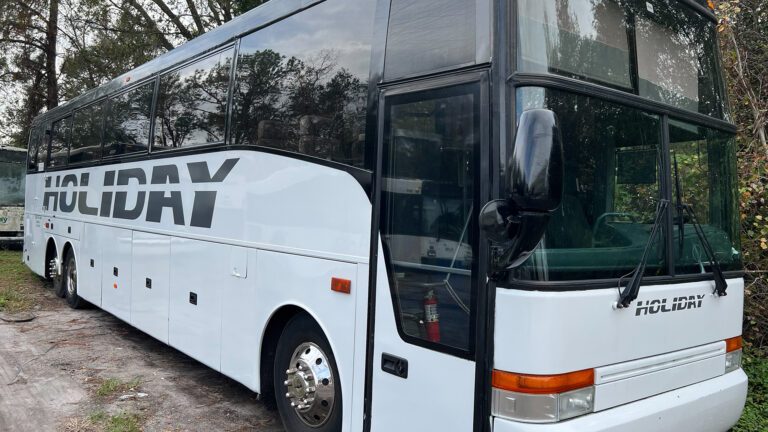
Holiday Coach Lines is family owned and operated, with over 138 years of combined industry experience. We are approved by the US Department of Transportation and the Interstate Commerce Commission.
Our motorcoaches carry 57 reclining seats, air conditioning, free Wi-Fi, and USB chargers. Our drivers are hand-picked for safety records and customer service.
Frequently Asked Questions
Why is regular maintenance important for charter buses?
Regular charter bus maintenance keeps brakes, tires, steering, and lighting in working order, which is what protects passengers on long highway runs. It also catches small faults before they become roadside breakdowns that ruin a wedding timeline or a tournament schedule. Federal rules require operators to keep vehicles in safe operating condition, and documented preventive service is how a company proves it. For group travel, maintenance is the difference between an on-time departure and a stranded group.
How often should a charter bus be inspected and serviced?
Most operators run a pre-trip inspection before every departure, a detailed monthly or mileage-based check on brakes, tires, fluids, and belts, and a full scheduled service at manufacturer intervals. A practical bus maintenance schedule ties these to mileage and engine hours rather than the calendar alone, since a coach running daily theme park shuttles accumulates wear faster than one used twice a month. Inspection intervals should shorten during peak season.
What maintenance records should a charter bus operator keep?
Keep pre-trip inspection sheets, repair invoices, parts and tire replacement logs, scheduled service dates and mileage, and driver-reported defect reports with the date each issue was resolved. These bus maintenance records support compliance reviews, show a vehicle’s service history to insurers, and help a fleet manager spot repeat failures on the same coach. Records should be retained for each vehicle individually so the full lifecycle is traceable.
What are common signs that a charter bus needs maintenance?
Drivers should report soft or spongy brakes, unusual tire wear, vibration at highway speed, warning lights, fluid leaks, uneven steering, or a drop in fuel efficiency. Passenger-facing clues include air conditioning that struggles, unusual noises, or doors that cycle slowly. A defect escalation process that gets these reports to the maintenance team the same day, rather than at the next scheduled service, is what keeps small issues from becoming cancellations.
Your group’s trip is only as reliable as the coach assigned to it, and that coach is only as reliable as the program behind it. Holiday Coach Lines builds every schedule around preventive service, documented inspections, and hand-picked drivers, so the bus shows up ready. Get started with Holiday Coach Lines and request a quote for your next group trip.